One number decides how much insulation your home actually needs. Here is what it means in plain language.
When you shop for insulation, one number comes up again and again: R-value. It is the standard measure of how well insulation resists heat, and it is the key to knowing how much insulation your Rio Grande Valley home actually needs.
This guide explains what R-value is in plain language, shows the targets for our climate zone, and gives clear recommendations for attics, walls, and floors. With a little understanding of R-value, you can make a smart, cost-effective choice instead of guessing.
Key takeaways
- R-value measures resistance to heat flow. Higher is better.
- The RGV is DOE Zone 2: attic R-30 to R-49, walls R-13 to R-21, floors R-13 to R-19.
- Closed-cell foam packs the most R-value per inch, at R-6 to R-7.
- R-value alone does not stop air leaks. Pair it with air sealing.
What is R-value?
R-value measures resistance to heat flow. The higher the R-value, the better the material slows heat from moving through it. That is the whole idea in one sentence.
In a Valley summer, heat wants to move from the hot outdoors and the 130 to 150 degree attic into your cool, air-conditioned rooms. Higher R-value insulation slows that transfer, so your AC runs less and your home stays comfortable. In our rare winter cold snap, the same insulation slows heat from leaving your home, keeping it warmer.
R-value adds up as you add thickness. Two inches of a material has roughly twice the R-value of one inch. That is why insulation is often described both by R-value per inch and by the total R-value of the finished layer.
R-value per inch of common insulation
Different materials pack different amounts of R-value into each inch. This matters when space is tight or when you want to reach a high total.
| Material | Approximate R-value per inch |
|---|---|
| Closed-cell spray foam | R-6 to R-7 |
| Open-cell spray foam | R-3.5 to R-3.8 |
| Blown-in cellulose | R-3.2 to R-3.8 |
| Fiberglass batt | About R-3 to R-4 |
| Blown-in fiberglass | R-2.2 to R-2.7 |
What R-value does a Valley home need?
Insulation targets are set by climate. The U.S. Department of Energy divides the country into climate zones, and the Rio Grande Valley falls into Zone 2. This is a hot zone, so the recommendations focus on keeping heat out. For most Valley homes, the general guidance is:
- Attic. Roughly R-30 to R-49. Many homeowners go R-38 or higher.
- Walls. Roughly R-13 to R-21.
- Floors. Over unconditioned space, commonly R-13 to R-19.
The attic is where the highest R-value pays off most, because that is where the worst heat load sits under the deep South Texas sun. If you only upgrade one area, the attic is usually the place to start.
How much attic insulation does a Valley home need?
Aim for roughly R-30 to R-49 in the attic, and many homeowners go R-38 or higher for stronger comfort and savings. Where you land depends on your home, your comfort goals, and your budget.
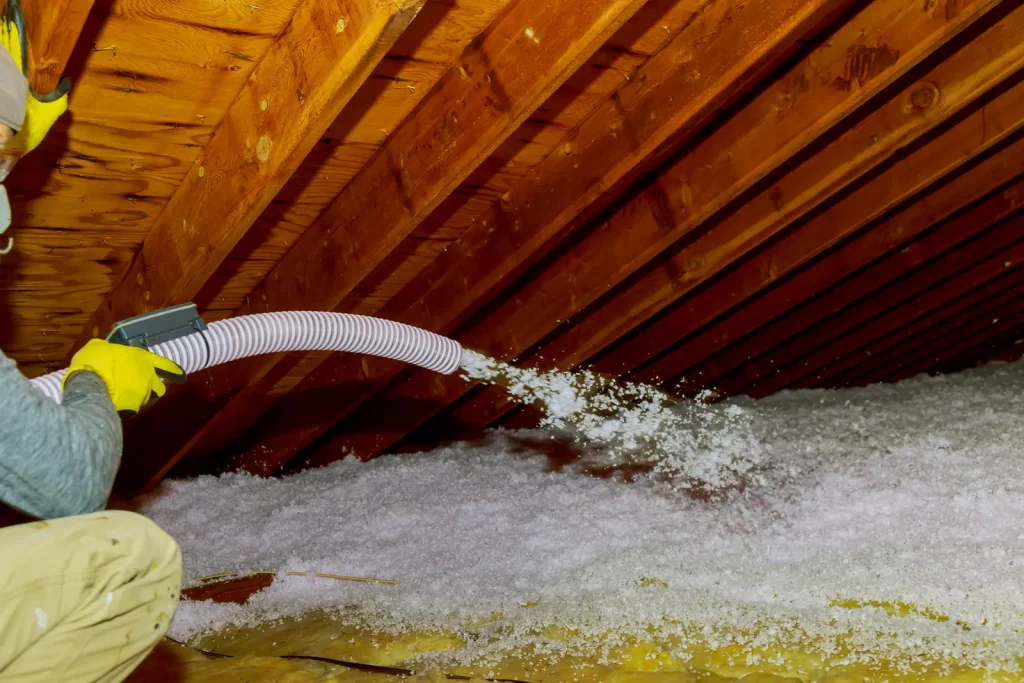
Many older RGV homes have far less than R-38, sometimes settled down to R-19 or below. Topping up to R-38 or higher is one of the most cost-effective upgrades available against high AEP Texas and Magic Valley Electric bills. Because attic space is usually open, you can build up thickness with cost-effective blown-in insulation to reach these levels. Pairing insulation with a radiant barrier is also popular in our intense sun.
Walls and floors
Walls typically target R-13 to R-21. The tricky part is that wall cavities have limited depth, so you cannot just add more inches like you can in an attic. This is where R-value per inch matters. In a standard 2×4 wall, batts or blown-in reach the R-13 range. In a deeper 2×6 wall, you can hit R-19 to R-21. When you need a high R-value in a shallow cavity, closed-cell spray foam packs the most R-value per inch, which is why it is a strong choice for tight wall spaces or exterior applications in the humid Valley.
Floors over unconditioned spaces, such as a pier-and-beam area common in older Valley homes, commonly target R-13 to R-19. Insulating these floors keeps conditioned air from escaping downward and helps with comfort and humidity. In damp pier-and-beam crawl spaces, closed-cell spray foam adds a moisture barrier along with its R-value, which is a real advantage in our climate.
Why R-value is not the whole story
R-value tells you how well insulation resists heat, but it does not account for air leaks. A home with high R-value insulation and lots of air leaks will still feel drafty and run up bills, because hot, humid Gulf air pours through the gaps.
That is why air sealing matters. Sealing leaks at top plates, penetrations, and can lights lets your insulation deliver its full rated R-value. In the Valley, the best results come from pairing the right R-value with good air sealing, and often a radiant barrier. Think of R-value and air sealing as a team, not competitors.
Frequently asked questions
What does R-value mean?
R-value is the measure of how well insulation resists heat flow. Higher R-value means better resistance, which in the Valley means less heat getting into your cooled rooms during our long summer.
What R-value do I need for a Valley attic?
Most RGV homes should target roughly R-30 to R-49 in the attic, and many go R-38 or higher, in line with DOE Zone 2 guidance. The attic is where high R-value pays off the most.
Does higher R-value always mean better?
Higher R-value resists heat better, but there is a point of diminishing returns for your budget, and R-value alone does not stop air leaks. The best results come from matching R-value to your climate and pairing it with air sealing.
Which insulation has the highest R-value per inch?
Closed-cell spray foam leads at about R-6 to R-7 per inch, followed by open-cell foam and cellulose. It is the top pick when you need high R-value in a shallow space or a moisture barrier for our humidity.
Can I just add more insulation to raise R-value?
In attics, yes, because you can build up thickness. In walls and floors, the cavity depth limits how much you can add, so the material you choose matters more.