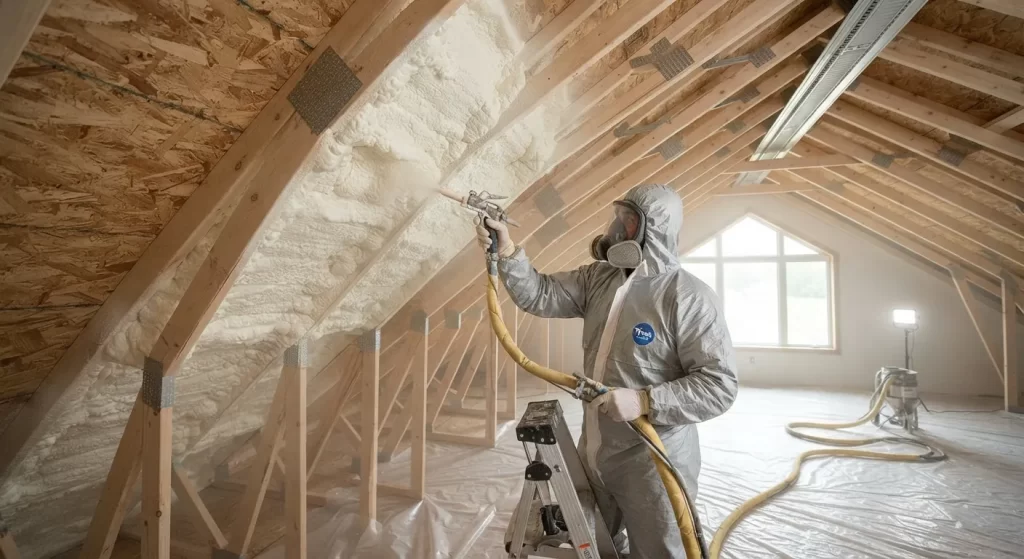
One is lighter, softer, and more affordable. The other is dense, high performing, and doubles as a moisture barrier.
Spray foam is one of the best insulation choices for the Rio Grande Valley climate, but there is an important decision to make before you book the job. Spray foam comes in two forms, open-cell and closed-cell, and they perform very differently. One is lighter, softer, and more affordable. The other is dense, high performing, and doubles as a moisture barrier, which is a big deal in our humid Valley air.
This guide compares them on R-value, moisture control, cost, and best uses so you can choose with confidence. Any cost figures here are estimates. Your real number depends on the job, which is why we offer free in-home quotes.
Key takeaways
- Closed-cell: about R-6 to R-7 per inch, rigid, and a vapor barrier.
- Open-cell: about R-3.5 to R-3.8 per inch, cheaper, better at sound.
- In the humid Valley, only closed-cell blocks moisture.
- Compare on total installed cost to your R-value target, not price per board foot.
What is the difference?
Both products start as liquids that expand and cure into foam, and both seal air leaks well. The difference is in their cell structure.
- Open-cell. Cells that are not fully closed, so the finished foam is soft, light, and spongy. Air fills the open cells, which makes the foam a great air barrier but allows some moisture vapor to pass through.
- Closed-cell. Tightly packed, fully closed cells. The result is dense and rigid. That density gives it a higher R-value per inch, adds structural strength, and blocks moisture vapor, making it a vapor and moisture barrier.
Open-cell vs closed-cell compared
| Feature | Open-cell | Closed-cell |
|---|---|---|
| R-value per inch | About R-3.5 to R-3.8 | About R-6 to R-7 |
| Density | Light and soft | Dense and rigid |
| Air barrier | Yes | Yes |
| Moisture / vapor barrier | No | Yes |
| Adds structural strength | Minimal | Yes |
| Sound dampening | Very good | Good |
| Cost per board foot (estimate) | About $1.50 to $2.50 | About $3.00 to $4.50 |
| Best uses | Interior walls, attic roof decks, sound control | Crawl spaces, rim joists, exterior walls, moisture-prone areas |
R-value: how much heat each foam resists
R-value measures resistance to heat flow, and higher is better. Closed-cell foam leads here with roughly R-6 to R-7 per inch, compared with about R-3.5 to R-3.8 per inch for open-cell.
That difference matters when space is tight. In a shallow wall cavity or a spot where you cannot add many inches, closed-cell lets you reach a higher R-value in less depth. In an open attic where thickness is not limited, open-cell can build up plenty of R-value at a lower cost.
For most Valley attics, the goal is roughly R-38 to R-60. Either foam can get you there, but the number of inches and the total cost will differ.
Moisture and humidity: a key Valley concern
The Rio Grande Valley is hot and humid for most of the year, and hurricane season brings tropical moisture off the Gulf. Moisture control is not an afterthought here. This is where the two foams really separate.
Closed-cell foam acts as a vapor and moisture barrier. It resists water intrusion and is a strong choice for pier-and-beam crawl spaces, rim joists, and exterior applications where dampness is a risk. In flood-prone or high-humidity settings common across the Valley, that barrier is a real advantage and helps guard against mold.
Open-cell foam allows some vapor to pass. That can be fine, and even helpful, in the right assembly, but it is not the choice when you specifically need to stop moisture. A good contractor will match the foam to the location and the building assembly so you do not trap moisture where it does not belong.
Cost: what you pay for each
Open-cell foam costs less per board foot, generally around $1.50 to $2.50 as an estimate, because it uses less material. Closed-cell foam is denser and higher performing, so it usually runs about $3.00 to $4.50 per board foot.
There is a wrinkle worth understanding. Because closed-cell delivers more R-value per inch, you may need fewer inches to hit your target, which narrows the gap on total installed cost. The best comparison is not price per board foot but total installed price to reach your R-value goal. We can lay both options side by side on your free quote.
Best uses for each type
- Open-cell makes sense. Interior walls where you want air sealing and sound dampening; attic roof decks in a conditioned attic assembly; larger areas where thickness is not restricted and budget matters; rooms where noise control is a priority.
- Closed-cell makes sense. Pier-and-beam crawl spaces and rim joists that face Valley moisture; exterior walls and areas exposed to weather and Gulf humidity; tight cavities where you need high R-value in few inches; any spot where a vapor and moisture barrier is important.
Many Valley homes use a mix, closed-cell where moisture and strength matter and open-cell where cost and sound control lead. There is no single right answer for every house.
Frequently asked questions
Which is better, open-cell or closed-cell spray foam?
Neither is universally better. Closed-cell wins on R-value per inch and moisture control, which matters in the humid Valley, while open-cell costs less and dampens sound well. The right pick depends on the location in your home and your goals.
Is closed-cell spray foam worth the extra cost?
Often yes, especially in crawl spaces, rim joists, and exterior or moisture-prone areas, or where you need high R-value in a shallow cavity. In open attics where thickness is not a limit, open-cell may deliver similar results for less.
Does open-cell spray foam hold water?
Open-cell foam allows some vapor to pass and is not a moisture barrier, so it should not be used where you specifically need to block water. Closed-cell foam is the moisture barrier of the two, which is why it is popular in the Valley.
How thick should spray foam be in a Valley attic?
It depends on the R-value target, roughly R-38 to R-60 for most RGV attics. Closed-cell reaches a given R-value in fewer inches than open-cell. We calculate the thickness during your free estimate.
Can I use both types in one house?
Yes. Many projects use closed-cell where moisture and structure matter and open-cell where cost and sound control lead. We can design a mix that fits your home and budget.