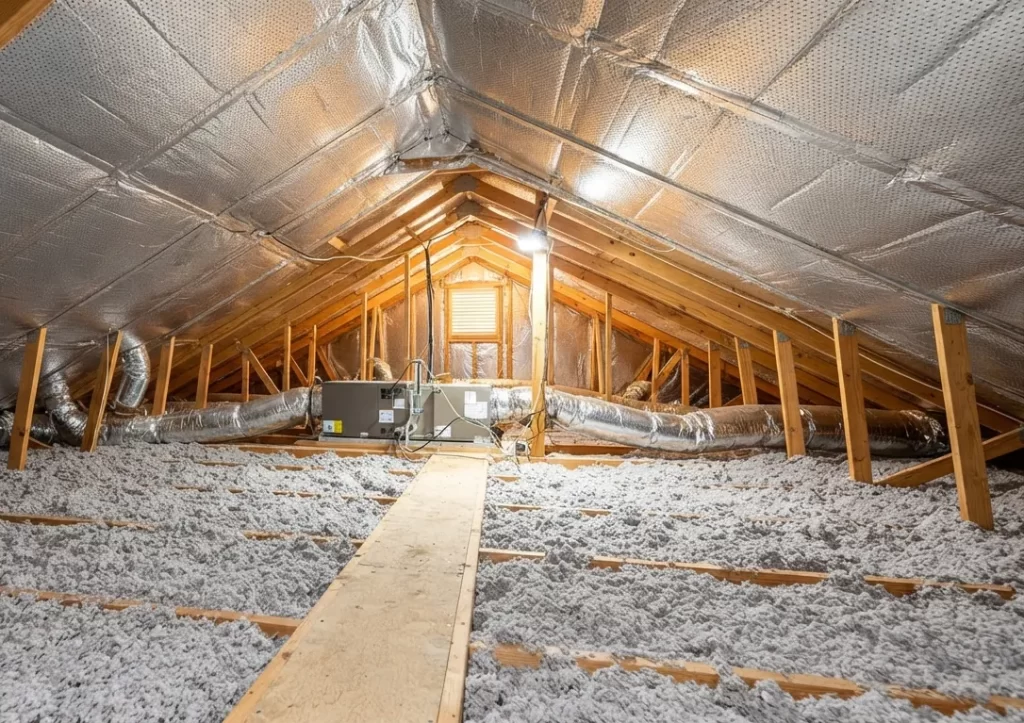
The goal here is not trapping heat in. It is keeping heat out and holding cool, dehumidified air in.
Insulating a home in the Rio Grande Valley is a different challenge than insulating one up north. Instead of trapping heat inside during cold winters, the goal here is to keep heat out and hold cool, dehumidified air in. Our summers are long, brutally hot, and humid, and Valley attics can reach 130 to 150 degrees. The best insulation for a hot, humid climate like the RGV is the one that handles heat and moisture while cutting your AEP Texas or Magic Valley Electric bill.
This guide walks through what makes the Valley different, which insulation types perform best here, and how to think about attic levels, air sealing, and radiant control.
Key takeaways
- The RGV sits in DOE climate Zone 2, where attics should reach roughly R-30 to R-49.
- Spray foam and blown-in are the top performers here; a radiant barrier helps either one.
- Closed-cell foam’s moisture barrier is a real advantage in our humidity.
- Air sealing is what makes any insulation actually perform.
What makes the Valley so hard on insulation?
Three things make the RGV climate demanding.
- Extreme attic heat. The intense South Texas sun beats down on your roof, and attic temperatures soar well above the outdoor air. That heat radiates down into your living space and forces your AC to run harder.
- Humidity. Tropical moisture in the air can find its way into walls and attics, and if insulation stays damp it loses effectiveness and can invite mold. Hurricane season only adds to the moisture load.
- Long cooling season. Because the AC runs for so much of the year in the Valley, any weakness in your insulation or air sealing shows up on your electric bill month after month.
Good insulation for the RGV has to slow radiant and conductive heat, resist moisture problems, and seal the home tightly.
How much attic insulation does a Valley home need?
Attic insulation matters more than anything else in a hot climate, because that is where the most heat enters. The Valley sits in DOE climate Zone 2, where the recommended attic insulation level is roughly R-30 to R-49, with many homes targeting R-38 or higher. R-value measures resistance to heat flow, and higher is better.
Many older Valley homes have far less than this, sometimes just a thin, settled layer that no longer does the job. Bringing the attic up to a proper level is often the single best upgrade for comfort and lower bills.
Which insulation types work best in the Valley?
Spray foam is popular across the RGV for good reason. It delivers high R-value per inch and, just as important, it seals air leaks that other insulation cannot. Open-cell foam runs about R-3.5 to R-3.8 per inch and closed-cell about R-6 to R-7 per inch.
Blown-in insulation is a workhorse for Valley attics. It fills the attic floor evenly and is a cost-effective way to reach high R-values. Loose-fill cellulose runs about R-3.2 to R-3.8 per inch, and blown-in fiberglass runs about R-2.2 to R-2.7 per inch. Blown-in is excellent for adding depth to an existing attic or topping up a thin layer. The one thing to remember is that blown-in slows heat but does not seal air leaks on its own. Pairing blown-in insulation with proper air sealing gives you the best of both worlds at a friendly price.
A radiant barrier is a reflective material installed in the attic, usually along the underside of the roof. Instead of slowing heat by resistance, it reflects radiant heat away, which is especially useful under the blazing Valley sun. A radiant barrier does not replace insulation, but it can work alongside it to keep attic temperatures down and reduce the heat load on your AC. In the RGV, where the sun is relentless from spring through fall, a radiant barrier is one of the smartest add-ons you can make.
Fiberglass batts are a budget-friendly choice for walls, floors, and some ceilings, typically providing R-13 to R-21 in walls. They are effective when installed carefully with no gaps or compression. For attics, most Valley homeowners get better coverage from blown-in or spray foam, but batts remain a solid option for wall cavities and new construction across the fast-growing RGV.
| Type | R-value per inch | Air seals | Best use here |
|---|---|---|---|
| Closed-cell spray foam | R-6 to R-7 | Yes, plus moisture barrier | Tight spaces, moisture-prone areas, metal buildings |
| Open-cell spray foam | R-3.5 to R-3.8 | Yes | Sealed attics, interior walls |
| Blown-in cellulose | R-3.2 to R-3.8 | No | Attic floors, topping up |
| Blown-in fiberglass | R-2.2 to R-2.7 | No | Attic floors where weight matters |
| Fiberglass batts | R-13 to R-21 in walls | No | Wall cavities, new construction |
| Radiant barrier | Reflects, no R-value | No | Under the roof deck, paired with insulation |
Spray foam vs blown-in: which is better for the Valley?
This is the question most homeowners ask, and the honest answer is that it depends on your priorities.
- Choose spray foam. If you want the best air sealing, the highest performance in a tight space, moisture control from closed-cell, and a cooler, conditioned attic. It costs more but delivers more, and the humidity control is a real plus in the RGV.
- Choose blown-in. If you want strong attic coverage at a lower cost, especially for topping up an existing attic. Add air sealing to close the gap on performance.
Many Valley homes do well with a combination: spray foam or careful air sealing where leaks are worst, plus generous blown-in depth across the attic floor, often paired with a radiant barrier. A professional can help you match the approach to your home and budget.
Do not forget air sealing
No matter which insulation you choose, air sealing is what makes it perform. Sealing leaks around top plates, penetrations, and can lights stops hot, humid Valley air from pouring in. Insulation slows heat, but without air sealing, air still moves right around it. In the RGV climate, the two work together to keep your home cool and comfortable and to hold down your electric bill.
Where a Valley house gains its heat
Sun on the roof
The roof deck soaks up sun all day and radiates that heat into the attic. On a summer afternoon the attic can run 130 to 150 degrees.
Through the ceiling
Attic heat pushes down through the ceiling. Thin or settled insulation lets more of it through.
Ducts in the attic
Cool air travels through ducts sitting in that heat. ENERGY STAR says about 20 to 30 percent of the air in a typical duct system is lost to leaks and poor connections.
Air leaks
Gaps at can lights, top plates, pipe holes and the attic hatch pull hot, damp air into the house.
Walls facing the sun
West and south walls take the afternoon sun. Block walls and older frame walls often have little or no insulation.
Humidity
Moisture in the air is part of the cooling load. The AC has to pull that water out as well as lower the temperature.
Walls, mobile homes and commercial buildings
Block homes
Some Valley homes are built with concrete block walls. The Department of Energy notes that filling block cores alone saves little, because heat moves through the solid parts of the block. Foam board across the face of the wall does more. See wall insulation for existing Valley homes.
Frame walls
Closed frame walls can often be filled through small holes. Open walls during a remodel take batts or foam. See batt and wall insulation.
Mobile and manufactured homes
These are built differently, often with a shallow roof cavity and an insulated belly under the floor. We look first and explain what is practical for your home.
Pier and beam floors
Less common here than slabs, but some older homes have them. Read crawl space and pier and beam insulation.
Commercial buildings
Metal roofs and walls heat up fast and can drip on humid mornings. Closed cell foam insulates the metal and limits that condensation. See commercial insulation.
New construction
Building new is the easiest time to get walls and the roof deck right. Read new construction insulation in the RGV.
Frequently asked questions
What is the best insulation for a hot, humid climate like the Valley?
There is no single answer for every home, but spray foam and blown-in are the top performers here. Spray foam adds air sealing and moisture control, while blown-in delivers cost-effective attic coverage. A radiant barrier can help either one by reflecting the intense Valley attic heat.
How much attic insulation do I need in the Valley?
The RGV falls in DOE Zone 2, where the recommended attic level is roughly R-30 to R-49. Many homes target R-38 or higher for the best comfort and savings.
Is spray foam worth it in the Valley?
For many homeowners, yes. Its air sealing, high R-value per inch, and moisture control make a real difference in a climate where the AC runs much of the year. It costs more up front, so weigh it against your budget and goals.
Does a radiant barrier replace insulation?
No. A radiant barrier reflects radiant heat but does not provide R-value on its own. It works best paired with attic insulation, and it is especially effective under the strong RGV sun.
Related reading and services
- Service: Attic insulation for Valley homes
- Service: Spray Foam Insulation
- Blog: Radiant Barrier vs Spray Foam in RGV Attics
- Blog: Fiberglass vs Spray Foam Insulation
- Blog: Blown-In vs Batt Insulation