The damage you can see gets attention first. The damage you cannot see is often in the attic and walls.
Hurricane season runs from June through November, and the Rio Grande Valley sits right in the path of tropical storms and wind-driven rain off the Gulf. When a storm blows through McAllen, Brownsville, Harlingen, or Weslaco, the damage you can see (shingles, siding, fences) gets attention first. The damage you cannot see is often in the attic and walls, where wet insulation quietly loses R-value and sets up mold in the Valley’s heavy humidity.
This guide explains how hurricane season affects your insulation, why closed-cell spray foam adds real protection, and what to check after a storm. Any costs mentioned are estimates, and a free in-home quote is the only way to know your real price.
Key takeaways
- The threat is water, not just wind. Wind-driven rain finds gaps ordinary rain never does.
- Wet insulation loses R-value, stays wet in Valley humidity, and grows mold.
- Closed-cell foam blocks moisture and adds rigidity to the roof assembly.
- Never blow new insulation over wet material. The wet layer has to come out first.
How does hurricane season affect insulation?
The threat is water, not just wind. During a tropical storm, rain does not fall straight down. It is driven sideways at high speed, so it finds gaps around roof vents, ridge caps, soffits, wall penetrations, and window flashing that never leak in an ordinary rain. Once water gets past the roof deck or wall sheathing, it soaks into whatever insulation is behind it.
Wet insulation is a problem for three reasons:
- It loses R-value. Damp fiberglass or cellulose does not resist heat flow the way dry insulation does, so your AC works harder and your AEP Texas or Magic Valley Electric bill climbs.
- It stays wet. In the humid Valley, an attic or wall cavity dries slowly, so moisture lingers for days or weeks.
- It grows mold. Warm, damp, dark cavities are ideal for mold, which can spread into framing and drywall and affect indoor air quality.
Why wind-driven rain matters more here
The Valley’s subtropical climate makes storm moisture worse than it would be in a drier region. After a storm, outdoor humidity stays high, so wet materials cannot dry out on their own. A batt of fiberglass that got soaked in a July storm can stay damp into August, sitting against wood framing the whole time. That is how a single storm turns into a mold and rot problem months later.
Older Valley homes are especially exposed. Many have attic insulation that was installed decades ago, with tired roof flashing and gaps at the soffits and eaves. Those are exactly the paths wind-driven rain uses to get inside.
Why closed-cell spray foam adds strength and a moisture barrier
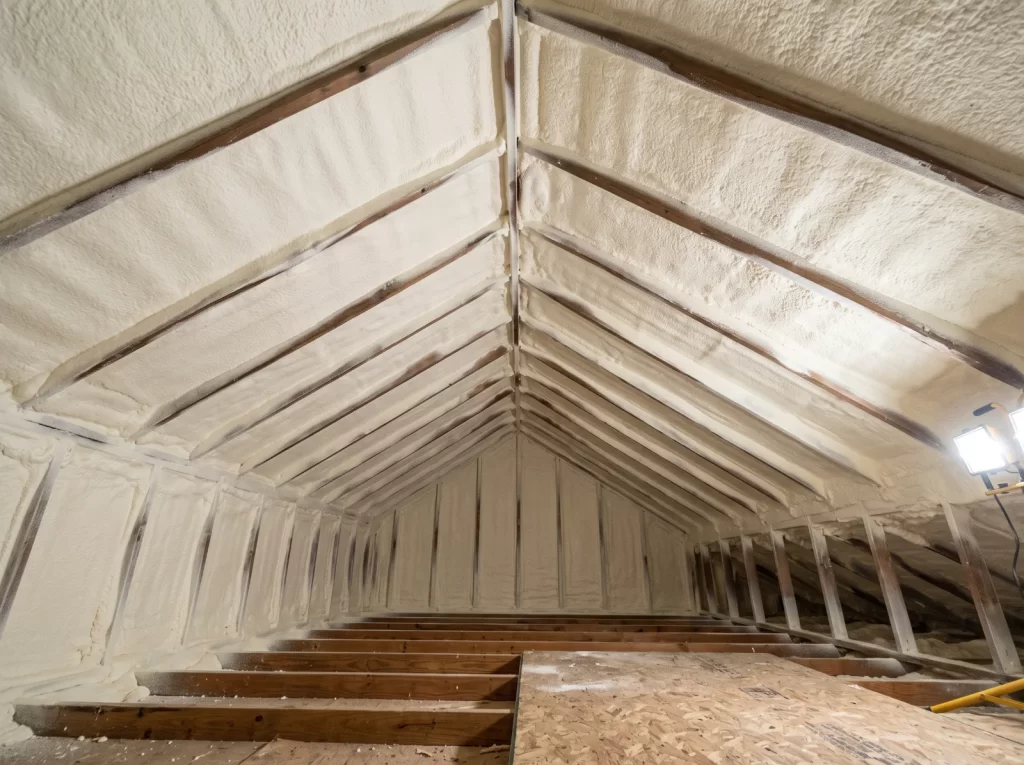
Closed-cell spray foam is the standout material for storm country, and it does double duty. It delivers roughly R-6 to R-7 per inch, and because the cells are closed and dense, it also acts as a vapor and moisture barrier. Water does not soak into it the way it soaks into loose-fill or batts.
Two benefits stand out during hurricane season:
- Moisture control. Applied to the underside of the roof deck or in wall cavities, closed-cell foam blocks the tropical moisture that drives Valley mold problems. It does not absorb water, so it does not become the wet sponge that fiberglass can.
- Added strength. Closed-cell foam is rigid once cured. Sprayed to the roof deck and framing, it adds structural rigidity that helps a roof assembly resist the racking and uplift forces of high wind. It also seals the countless small gaps where wind-driven rain sneaks in.
For homeowners who want the strongest defense against storm moisture, closed-cell spray foam in the attic or walls is the upgrade we recommend most in the Valley. Open-cell foam and traditional materials still have their place, but closed-cell is the one that builds a moisture barrier into the insulation itself.
How to check insulation after a storm
After a hurricane or tropical storm passes and it is safe to go up, do a careful check. Wet insulation is not always obvious from the living space.
- Signs to look for. Water stains on the ceiling, especially near vents, valleys, and the edges of rooms. A musty or damp smell in closets, the attic, or along exterior walls. Insulation that looks matted, discolored, sagging, or compressed. Visible daylight or water tracks around roof penetrations and soffits. Higher humidity or condensation inside the home after the storm.
- What to do next. Photograph any damage for your insurance claim before anything is moved. Do not leave wet insulation in place, since it will not dry and mold will start. Have wet or contaminated insulation removed, the cavity dried, and the leak fixed. Replace with new insulation once the space is dry, and consider closed-cell foam for better storm resistance.
Do not simply blow new insulation on top of wet material. That traps the moisture and the mold underneath. The wet layer has to come out first.
Replacing wet insulation and controlling mold
When insulation gets soaked, replacement is usually the right call, not drying and reusing. Loose-fill and batts that have been saturated lose their loft and their R-value, and paper-based cellulose especially can hold mold even after it looks dry. The process is straightforward: remove the wet insulation, clean and dry the cavity, address the leak that let water in, treat any mold, and install fresh insulation.
This is also the moment to upgrade. If a storm forces you to open up an attic anyway, replacing old fiberglass with closed-cell spray foam gives you a moisture barrier and a stronger, better-sealed home for the next storm season. Controlling mold in the Valley comes down to keeping cavities dry, and the right insulation is a big part of that.
Frequently asked questions
Should I replace insulation that got wet in a storm?
Usually yes. Saturated fiberglass and cellulose lose R-value and can hold mold even after they appear dry. Removing wet insulation, drying the cavity, fixing the leak, and installing fresh material is the safe, lasting fix.
Does spray foam help against hurricanes?
Closed-cell spray foam helps in two ways. It acts as a moisture barrier that resists wind-driven rain, and once cured it is rigid, adding strength to the roof assembly and sealing gaps where storm water gets in.
How do I know if my attic insulation is wet after a storm?
Look for water stains, a musty smell, and insulation that looks matted, discolored, or sagging. Check around roof vents, valleys, and soffits where wind-driven rain enters. When in doubt, have it inspected.
Can wet insulation cause mold in a Valley home?
Yes. The Valley’s high humidity means wet cavities dry very slowly, giving mold time to grow into insulation, framing, and drywall. Removing wet insulation quickly is the best way to prevent it.
When is the best time to upgrade insulation for hurricane season?
Before the season, ideally in spring, or right after storm damage forces a replacement. Upgrading to closed-cell spray foam during a repair adds a moisture barrier and storm strength for future seasons.
Related reading and services
- Service: Insulation removal and replacement
- Service: Spray foam insulation
- Cornerstone: Best Insulation for the RGV: Types Compared
- Blog: Open-Cell vs Closed-Cell Spray Foam
- Blog: Insulation and Mold: Controlling Humidity in the Valley
- Blog: Insulation Removal: When and Why It Is Necessary