The short answer is yes. How much depends on your home, your current insulation, and how leaky your house is today.
If you live in the Rio Grande Valley, your air conditioner is one of the hardest working systems in your home. It runs most of the year, and your AEP Texas or Magic Valley Electric bill shows it. So it is a fair question to ask whether spray foam insulation actually lowers your electric bill, or whether it is just a premium product with a premium price tag. The short answer is yes, spray foam can lower your bills, and in the Valley’s brutal heat the savings can be meaningful. The longer answer is that how much you save depends on your home, your current insulation, and how leaky your house is today.
This guide breaks down exactly how spray foam saves money, what kind of savings Valley homeowners can expect, and how to think about payback.
Key takeaways
- Spray foam saves twice: high R-value plus a continuous air seal.
- The leakiest, least-insulated homes see the biggest drop.
- Foaming the roof deck brings the attic into the conditioned envelope.
- Payback is faster here because the AC runs most of the year.
How does spray foam save money?
Spray foam lowers electric bills in two ways at once. It slows heat flow like any insulation, and it seals air leaks that other insulation cannot. That combination is what sets it apart, and it matters even more in the humid RGV.
- Air sealing. Most homes lose a surprising amount of conditioned air through small gaps and cracks, around top plates, wiring, plumbing penetrations, can lights, and the attic hatch. Traditional batts and blown-in insulation slow heat, but air still moves right around them. Spray foam expands as it cures and fills those gaps, forming a continuous air barrier. In a Valley summer, that means your AC does not have to fight a constant stream of hot, sticky outdoor air, and it does not have to work as hard to pull humidity back out of the house.
- High R-value per inch. Spray foam delivers strong R-value in a thinner layer than most other options. Open-cell foam runs about R-3.5 to R-3.8 per inch, and closed-cell foam runs about R-6 to R-7 per inch. Closed-cell also acts as a vapor and moisture barrier, which is a real advantage against the tropical humidity the Valley is known for.
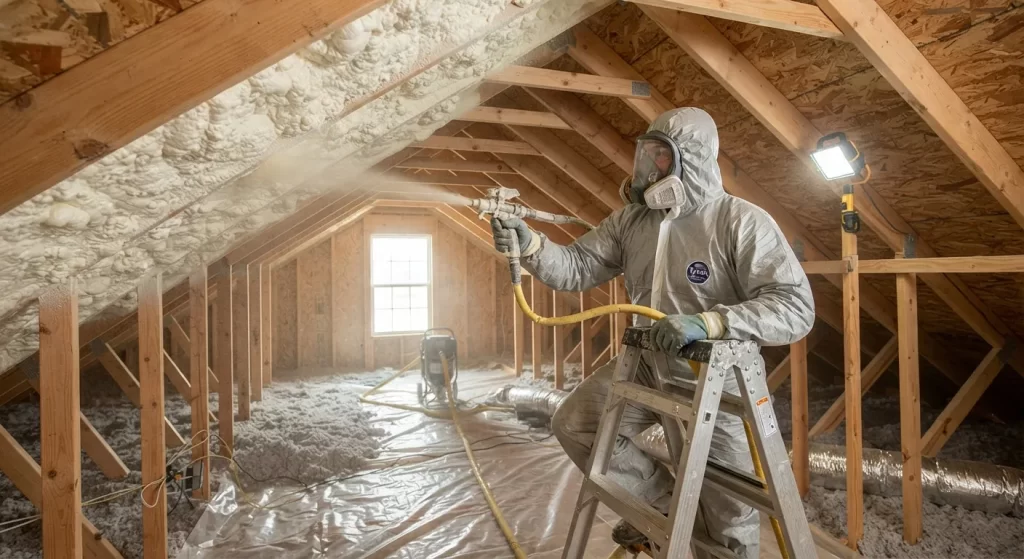
- Cooler attics. Valley attics can reach 130 to 150 degrees in summer. Applied to the underside of the roof deck, spray foam can bring the attic into the home’s conditioned envelope, so it stays far cooler. That protects any ductwork running through the attic and takes a big load off your air conditioner. Less strain often means lower bills and a longer equipment life.
How much can you save on your electric bill?
This is where honesty matters. Savings vary from home to home, so treat any number as an estimate rather than a guarantee.
Homeowners who upgrade from old, thin, or leaky insulation to a well-sealed spray foam system often see a noticeable drop in cooling costs. The biggest savings usually come to homes that were poorly insulated and leaky to begin with, because there is more waste to eliminate. A home that already has decent insulation and good air sealing will see a smaller change.
Your actual savings depend on how much insulation you have now and its condition, how leaky your home is today, the size and age of your AC system, your thermostat habits and your AEP Texas or Magic Valley Electric rate, and whether ductwork runs through an unconditioned Valley attic. Because of all these variables, the only way to get a real estimate for your home is an in-person assessment.
What about payback? Is spray foam worth the cost?
Spray foam costs more up front than blown-in or batt insulation. As a rough estimate, spray foam runs about $1.50 to $4.50 per board foot, while blown-in attic insulation runs closer to $1.50 to $3.50 per square foot. The exact price depends on the job, the foam type, and the thickness required.
The way to think about payback is simple. The money you save each month on cooling gradually offsets the higher install cost. In the Valley, where the AC runs the better part of the year, the monthly savings from air sealing and high R-value tend to add up faster than they would in a milder region. Many homeowners also value the added comfort, quieter rooms, and better humidity control, which do not show up on a utility bill but are real benefits in our climate.
Keep in mind that payback timelines are estimates. A leaky, under-insulated home will pay the foam back faster than a home that was already efficient. A free in-home estimate is the best way to understand the numbers for your specific situation.
Open-cell or closed-cell for energy savings?
Both save energy, but they do it a little differently.
- Open-cell. Lighter, expands more, and costs less. An excellent air barrier and a common choice for Valley attics and interior walls.
- Closed-cell. Denser, delivers more R-value per inch, adds structural strength, and blocks moisture. Costs more but performs well in tight spaces and moisture-prone areas, which makes it a favorite for humidity and storm resistance in the RGV.
For many Valley attics, open-cell offers a strong balance of air sealing and value, while closed-cell shines where space is limited or moisture control is a priority. The right choice depends on your home and goals.
Frequently asked questions
Does spray foam really lower my electric bill?
Yes. By combining a strong air seal with high R-value, spray foam reduces the amount of conditioned air your home loses, which can lower your cooling costs. The size of the savings depends on your current insulation and how leaky your home is.
How long until spray foam pays for itself?
Payback varies by home and is best treated as an estimate. Homes that were leaky and under-insulated tend to recover the cost faster because the monthly savings are larger. A free assessment gives you a realistic timeline.
Is spray foam better than blown-in for saving money?
Spray foam adds air sealing that blown-in does not, so it often delivers more energy savings, but it also costs more up front. Blown-in remains a strong, budget-friendly option, especially when paired with separate air sealing.
Will spray foam help with Valley humidity?
Closed-cell spray foam acts as a moisture barrier, and both foam types reduce the leakage of humid outdoor air into your home, which helps with comfort and mold control in the RGV climate.
Related reading and services
- Service: Spray foam insulation services in the Valley
- Cornerstone: Compare insulation types for the Valley
- Blog: Spray Foam Insulation Cost in the RGV (2026)
- Blog: Open-Cell vs Closed-Cell Spray Foam
- Blog: Air Sealing vs Insulation: Why Your Home Needs Both