One reflects heat away. The other seals and insulates the space. Knowing the difference is how you spend your money where it counts.
If your attic feels like an oven and your AC never seems to catch up, you have probably read about two popular fixes: radiant barrier and spray foam. Both help keep a Rio Grande Valley attic cooler, but they do very different jobs. One reflects heat away, and the other seals and insulates the space. Understanding the difference helps you spend your money where it actually counts, especially when your AEP Texas or Magic Valley Electric bill climbs all summer long.
Here is a plain-English breakdown of radiant barrier vs spray foam: how each works, what they cost, when to use them, and whether you can combine the two for the best result in the Valley heat.
Key takeaways
- A radiant barrier reflects heat. Spray foam blocks and seals it.
- A barrier adds no meaningful R-value and does not stop air leaks or humidity.
- Spray foam runs roughly $1.50 to $4.50 per board foot, closed-cell at the higher end.
- Combining them makes sense with attic-floor insulation, not with a foamed roof deck.
How does a radiant barrier work?
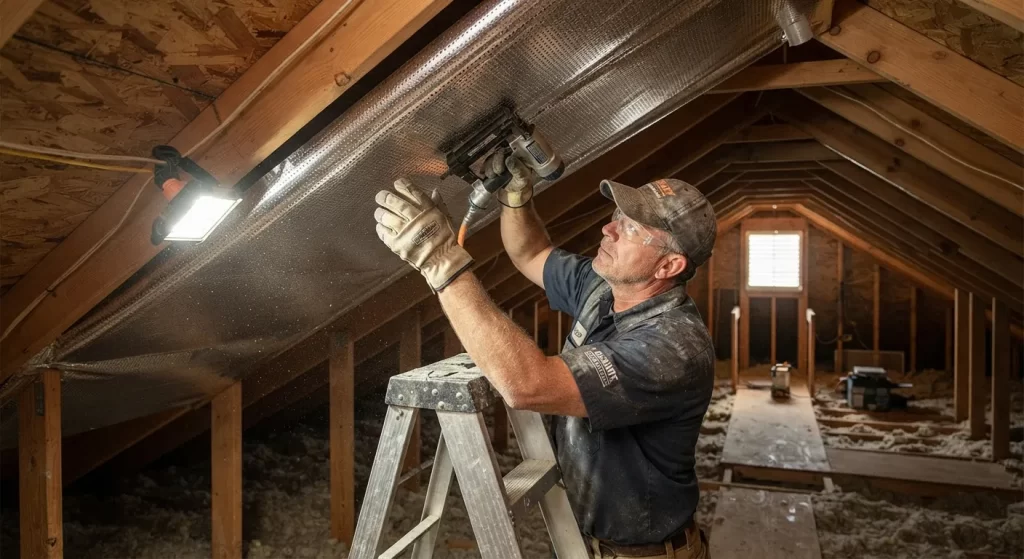
A radiant barrier is a thin, reflective material, usually a foil-faced sheet, that installers staple to the underside of the roof rafters or lay over existing attic insulation. It does not slow heat the way a thick blanket of insulation does. Instead, it reflects radiant heat.
Here is why that matters in the Valley. On a brutal summer afternoon, your roof soaks up the intense South Texas sun and reradiates that heat down into the attic, where temperatures climb to 130 to 150 degrees. A radiant barrier bounces much of that radiant heat back toward the roof, so less of it reaches your insulation and your ceilings below. The result is a cooler attic and an AC system that does not have to fight as hard.
Radiant barrier works best when it faces an air gap and stays clean and dust-free. It is a supplement to insulation, not a replacement. On its own it does little to stop conductive heat, and nothing to seal air leaks or control humidity.
How does spray foam work?
Spray foam is a very different product. It is applied as a liquid that expands and hardens into a solid layer of insulation. In an attic, it is often sprayed against the underside of the roof deck to create a sealed, conditioned attic, or “hot roof” assembly.
Spray foam does two things at once. It insulates, slowing heat that travels by conduction, and it air seals, closing the gaps and cracks where hot, humid Valley air leaks in. There are two main types:
- Open-cell. Roughly R-3.5 to R-3.8 per inch, a strong air barrier, lighter and more affordable.
- Closed-cell. Roughly R-6 to R-7 per inch, denser, adds structural strength, and also acts as a vapor and moisture barrier. That moisture control is a real advantage in our humid, hurricane-prone climate. It costs more.
Because spray foam seals the attic, it can bring your attic temperature much closer to the temperature inside your home. That is a big deal in the Valley, where a leaky, superheated attic drives up cooling costs from spring through fall.
The key difference
The simplest way to think about it: a radiant barrier reflects heat, while spray foam blocks and seals it.
A radiant barrier reduces the radiant heat load coming off your roof, which lowers attic temperatures and eases the strain on your AC. But it is a single-purpose tool. It does not add meaningful R-value, and it does not stop air leaks or humidity.
Spray foam is a complete insulation and air-sealing system. It addresses conduction, convection, and air infiltration all at once, and closed-cell foam adds moisture control on top of that. That makes it far more powerful, but also more expensive. In short, a radiant barrier is a targeted upgrade, and spray foam is a whole-attic solution.
How much does each one cost?
Costs vary by attic size, access, and the material you choose, so treat these as rough estimates. Always get a written quote for your specific Valley home.
- Radiant barrier. Typically one of the more affordable attic upgrades because the material is thin and installs relatively quickly. Pricing depends heavily on attic size and whether crews are working around existing insulation and obstacles.
- Spray foam. Runs roughly $1.50 to $4.50 per board foot, with closed-cell at the higher end. Sealing an entire roof deck uses a lot of material, so this is a larger investment.
Because spray foam does more, it costs more. A radiant barrier is a smaller upfront expense but delivers a narrower benefit. During a free estimate, we can price both options for your attic so you can compare real numbers instead of ballpark figures.
When should you use each one?
- Radiant barrier. Your attic already has good insulation levels but still runs extremely hot; you want to reduce cooling costs without a full insulation overhaul; your ductwork runs through the attic and you want to protect it from radiant heat; or you are looking for a lower-cost improvement to pair with existing blown-in or batt insulation.
- Spray foam. You want maximum comfort and the biggest cut in air leakage; you want a sealed, conditioned attic to protect HVAC equipment and ducts; you want to fight humidity and moisture, not just heat; you are dealing with a very leaky home or building a new one; or you want high R-value in limited space, such as tight rafter cavities.
If your attic insulation is thin, matted, or missing, a radiant barrier alone will not fix the problem. In that case, adding or topping up insulation usually comes first.
Can you combine radiant barrier and spray foam?
Yes, and in some homes it makes sense, though it is often unnecessary.
If you install spray foam against the roof deck to create a sealed attic, that foam is already blocking most of the heat, so a radiant barrier adds little extra benefit. In that setup, the two would be doing overlapping jobs.
Where combining shines is with traditional insulation. Many Valley homes use blown-in or batt insulation on the attic floor plus a radiant barrier on the rafters. The barrier reflects radiant heat, and the insulation blocks conduction, giving you strong performance at a lower cost than full spray foam. The right combination depends on your attic, your budget, and your goals, which is exactly what a free in-home estimate is for.
Frequently asked questions
Is spray foam better than a radiant barrier?
Spray foam does more because it insulates and air seals, while a radiant barrier only reflects radiant heat. For overall comfort, energy savings, and humidity control in the Valley, spray foam is usually more effective, but it also costs more. A radiant barrier can be a great value when your insulation is already solid.
Will a radiant barrier lower my electric bills in the Valley?
It can help by reducing radiant heat gain and easing the load on your AC, especially if your ductwork runs through a hot attic. The savings on your AEP Texas or Magic Valley Electric bill are typically modest compared with a full insulation and air-sealing upgrade, but the upfront cost is lower too.
Do I need a radiant barrier if I have spray foam?
Usually not. If spray foam already seals your roof deck and creates a conditioned attic, it is handling the heat, so a radiant barrier would be redundant. A barrier makes more sense with traditional attic-floor insulation.
Which lasts longer, radiant barrier or spray foam?
Both can last for decades when installed correctly. A radiant barrier can lose some effectiveness if it gets coated in attic dust over time, while spray foam stays in place and keeps performing. Proper installation matters most for both.
Related reading and services
- Service: Attic Insulation and Radiant Barrier
- Service: Spray Foam Insulation
- Cornerstone: Best Insulation for the Rio Grande Valley
- Blog: Open-Cell vs Closed-Cell Spray Foam
- Blog: Attic Insulation: The Complete RGV Homeowner’s Guide