Every figure here is an estimate. The only way to know your real price is a free in-home quote.
If you are shopping for spray foam insulation in the Rio Grande Valley, the first question is almost always about price. Spray foam is one of the best-performing insulation options for our hot, humid climate, but it also costs more up front than blown-in or batt insulation.
This guide breaks down how spray foam is priced in 2026, what you can expect to pay by project, and the factors that move the number up or down. Every figure below is an estimate. The only way to know your real price is a free in-home quote, because a quote always depends on the job.
Key takeaways
- Spray foam is priced by the board foot: one square foot at one inch thick.
- Roughly $1.50 to $4.50 per board foot installed, open-cell low, closed-cell high.
- A typical RGV attic often lands between $3,500 and $9,000.
- Closed-cell needs fewer inches, which narrows the total-cost gap.
How is spray foam insulation priced?
Most contractors in the Valley price spray foam by the board foot. One board foot equals one square foot of area sprayed to a thickness of one inch. So a 100 square foot wall sprayed to 3 inches is 300 board feet.
As a rough estimate, spray foam runs about $1.50 to $4.50 per board foot installed. That range is wide because it covers two very different products, open-cell and closed-cell foam, plus differences in job size, access, and prep work.
Pricing by the board foot is helpful because it accounts for both the area you are covering and how thick the foam needs to be to hit your target R-value. A thicker application uses more material and costs more.
Open-cell vs closed-cell spray foam cost
The biggest driver of spray foam price is which type you choose.
- Open-cell. Lighter and less dense. Roughly R-3.5 to R-3.8 per inch, an excellent air barrier, and costs less. Typically around $1.50 to $2.50 per board foot as an estimate. Popular for interior walls and attic roof decks where moisture control is less of a concern.
- Closed-cell. Denser and higher performing. About R-6 to R-7 per inch, adds structural rigidity, and doubles as a vapor and moisture barrier. Usually around $3.00 to $4.50 per board foot as an estimate. In the humid Valley it is the go-to for pier-and-beam crawl spaces, rim joists, and exterior applications.
Because closed-cell packs more R-value into each inch, you may need fewer inches to reach the same R-value, which can partly offset its higher per-inch cost. A good contractor will help you compare the two on total installed cost for your specific project.
Whole-home spray foam cost estimates
Homeowners often want a ballpark for a full project. The estimates below assume standard access and typical Valley construction. Treat them as starting points, not guarantees.
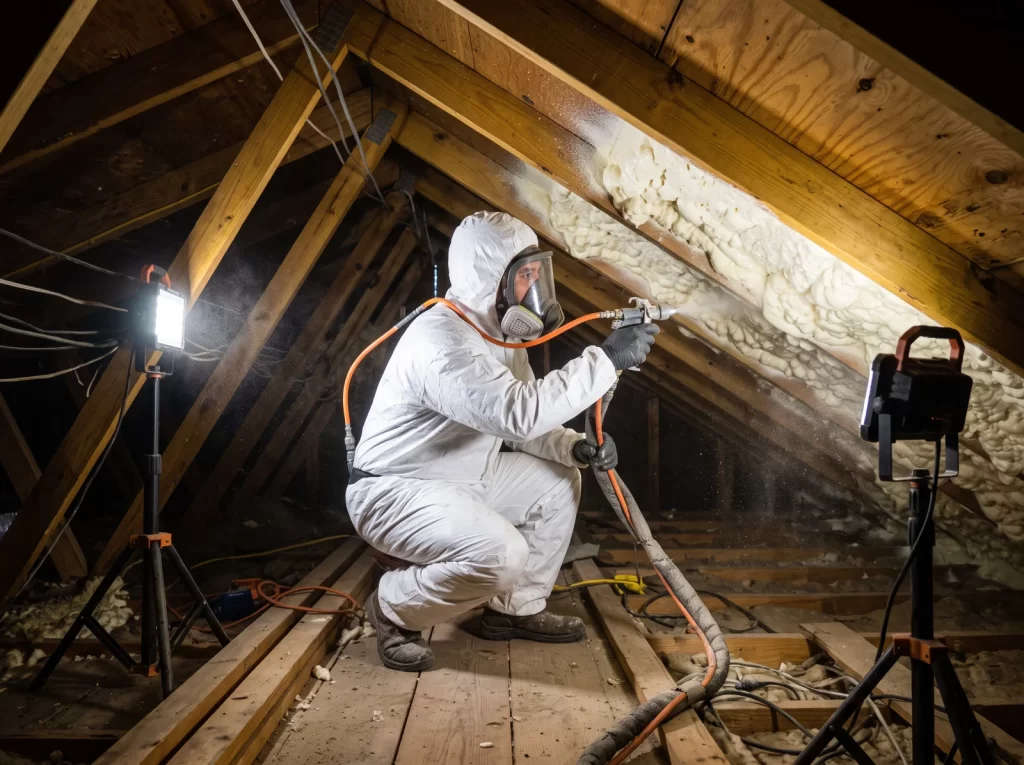
- Attic. Insulating a typical RGV attic with spray foam, on the roof deck or attic floor, commonly runs a few thousand dollars, often in the range of $3,500 to $9,000 depending on square footage, foam type, and thickness.
- Whole-home new construction. Spraying walls and the attic in a new build can range widely, frequently from $8,000 to $20,000 or more for larger homes. New construction is booming across McAllen, Edinburg, and Brownsville, and many builders spec spray foam from the start.
- Single area or add-on. Smaller jobs like a garage ceiling, a bonus room, or a section of wall may run several hundred to a few thousand dollars.
These numbers move with the size of your home, the R-value you are targeting, and whether you choose open-cell or closed-cell foam.
What affects the price of spray foam insulation?
Several factors explain why two homes of the same size can get different quotes.
- Square footage and thickness. More area and thicker foam mean more material and labor. Hitting a high attic R-value takes more inches, which raises board-foot totals.
- Foam type. Closed-cell costs more per board foot than open-cell because it is denser and higher performing.
- Access and prep. Tight attics, steep roof pitches, and hard-to-reach cavities take longer to spray. If old insulation has to be removed first, that adds to the total. Damaged or contaminated insulation may need removal and sanitizing before new foam goes in.
- Air sealing and conditions. Spray foam is an air barrier by nature, but homes with major leaks, unusual framing, or moisture issues may need extra prep so the foam performs as intended.
- Location and season. Local demand and scheduling can influence pricing. Summer is peak season in the Valley because attics reach 130 to 150 degrees and homeowners feel the difference most when their AC bills spike.
Is spray foam worth the higher cost in the Valley?
Spray foam costs more up front than blown-in or batt insulation, but it earns its keep in our climate. Valley summers push attic temperatures to 130 to 150 degrees, and that heat drives up cooling bills from AEP Texas and Magic Valley Electric Cooperative. Spray foam seals air leaks and delivers high R-value per inch, which helps keep conditioned air inside and hot, humid Gulf air out. Many homeowners see lower monthly electric bills and more even temperatures room to room. Closed-cell foam also helps control moisture, which matters a great deal in our subtropical, hurricane-season humidity. Savings vary by home, so we frame energy savings as estimates rather than promises.
Frequently asked questions
How much does spray foam insulation cost per board foot in the RGV?
As an estimate, spray foam runs about $1.50 to $4.50 per board foot installed. Open-cell foam tends toward the lower end and closed-cell toward the higher end. Your exact price depends on the job.
Is closed-cell spray foam worth the extra money?
It can be, especially in the humid Valley where you need a moisture barrier and added structure, such as pier-and-beam crawl spaces, rim joists, and exterior walls. Closed-cell also packs more R-value per inch, so you may need fewer inches. We can compare both options on your free quote.
How much does it cost to spray foam an attic?
A typical RGV attic often falls in the range of $3,500 to $9,000 as an estimate, depending on square footage, foam type, and target R-value. Removal of old insulation, if needed, adds to the total.
Does spray foam insulation save money on electric bills?
Many Valley homeowners see lower cooling costs because spray foam seals leaks and resists heat well. Actual savings vary by home, so we describe them as estimates, not guarantees.
Why is spray foam more expensive than blown-in insulation?
Spray foam uses more material and specialized equipment, and it provides air sealing plus high R-value per inch in one step. Blown-in insulation is cheaper up front but does not air seal on its own.
Related reading and services
- Service: Spray foam insulation
- Cornerstone: Best Insulation for the RGV: Types Compared
- Blog: Open-Cell vs Closed-Cell Spray Foam
- Blog: Does Spray Foam Lower Your Electric Bill in the Valley?
- Blog: Fiberglass vs Spray Foam Insulation